


Page 10 - Demo
P. 10
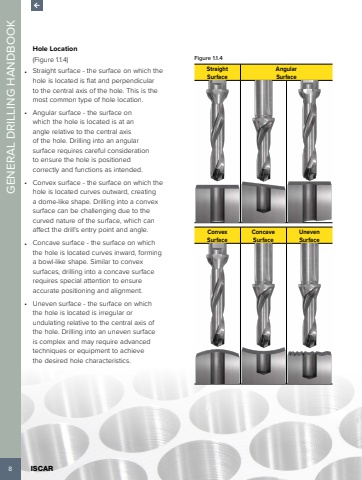
8 ISCAR GENERAL DRILLING HANDBOOKHole Location (Figure 1.1.4)%u2022 Straight surface - the surface on which the hole is located is flat and perpendicular to the central axis of the hole. This is the most common type of hole location. %u2022 Angular surface - the surface on which the hole is located is at an angle relative to the central axis of the hole. Drilling into an angular surface requires careful consideration to ensure the hole is positioned correctly and functions as intended.%u2022 Convex surface - the surface on which the hole is located curves outward, creating a dome-like shape. Drilling into a convex surface can be challenging due to the curved nature of the surface, which can affect the drill's entry point and angle.%u2022 Concave surface - the surface on which the hole is located curves inward, forming a bowl-like shape. Similar to convex surfaces, drilling into a concave surface requires special attention to ensure accurate positioning and alignment.%u2022 Uneven surface - the surface on which the hole is located is irregular or undulating relative to the central axis of the hole. Drilling into an uneven surface is complex and may require advanced techniques or equipment to achieve the desired hole characteristics.Figure 1.1.4StraightSurfaceAngularSurfaceConvex SurfaceConcave SurfaceUneven Surface


